Go further · Chapter 12 · 12c · People story
Who built the first atomic clock?
The short answer (tap to open)
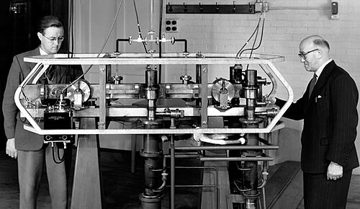
In 1955 Louis Essen and Jack Parry at Britain's National Physical Laboratory in Teddington built the first accurate caesium atomic clock. It kept time by counting the steady switching of caesium atoms between two energy levels. It was so accurate that in 1967 the world redefined the second using caesium, a definition that still stands.

How did a clock move time from the planet to the atom?
Card 1 · The problem
In the 1940s the Earth's rotation defines the second. But the Earth wobbles and slows, so the best clocks, quartz crystals, are measuring against a ruler that bends.
Card 2 · The idea
Atoms switch between energy levels at exactly fixed rates (chapter 1). Every caesium atom is identical. Count the switches and you have a clock that no planet's wobble can affect.
Card 3 · Teddington, 1955
Louis Essen, a physicist at the National Physical Laboratory who had already measured the speed of light more accurately than anyone before him, builds a caesium beam clock with Jack Parry. In June 1955 it runs. It would gain or lose about a second in 300 years.
Card 4 · The comparison
Essen works with US astronomers to compare his clock against the stars over several years. They pin down how many caesium switches make up one astronomical second.
Card 5 · 1967
The international body for measurement redefines the second as exactly 9,192,631,770 caesium switches. Time is no longer set by the planet but by atoms.
Card 6 · Since then
Atomic clocks fly on every GPS satellite (the introduction) and time the internet, phone networks and financial markets. Today's best optical clocks are about a hundred million times more precise than Essen's, and scientists plan a new definition of the second (page 12a).
Card 7 · A twist
Essen was a fierce critic of Einstein's relativity, even though the clocks he pioneered later confirmed relativity's predictions about time with exquisite precision.
Check
One quick one
Collect
Your aha card
From the planet to the atom.
Essen's 1955 clock moved the world's timekeeping onto quantum energy steps.
Next in the path · Chapter 13
How does quantum keep secrets, and will it break today's encryption?
Next in the path