Go further · Chapter 7 · 7c · People story
Who came up with the idea of a quantum computer?
The short answer (tap to open)
Several people had the idea around 1980, including Paul Benioff and Yuri Manin. Richard Feynman made it famous in a 1981 talk near Boston, arguing that only a computer built on quantum rules could simulate nature efficiently. In 1985 David Deutsch described a universal quantum computer, and in 1994 Peter Shor showed what one could break.
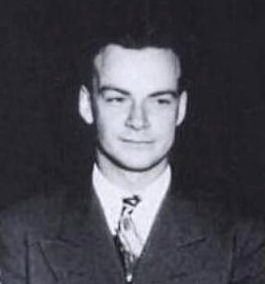

How did one talk launch quantum computing?
Card 1 · The showman
Richard Feynman is a Nobel laureate (1965), a bongo player, a safecracker for fun at Los Alamos and America's most famous physics teacher. He's also an outsider to computing, which helps.
Card 2 · May 1981
MIT and IBM bring physicists and computer scientists together at Endicott House, a mansion outside Boston, for a conference on the physics of computation.
Card 3 · The question
Feynman asks: can an ordinary computer simulate nature exactly? For quantum systems, he argues, the work explodes as the system grows (chapter 7's doubling problem). Nature itself has no trouble.
Card 4 · The answer
So build the computer out of quantum parts. His talk ends with a now famous line: "Nature isn't classical, dammit." If you want to simulate it, he says, make the simulation quantum.
Card 5 · Not alone
Paul Benioff had already described a computer running on quantum mechanics in 1980, and Yuri Manin had raised the idea in the Soviet Union. Feynman's fame put it on the map.
Card 6 · The theory catches up
In 1985 David Deutsch at Oxford describes a universal quantum computer. In 1994 Peter Shor shows it could break encryption, and money starts to flow.
Card 7 · The legacy
Feynman dies in 1988, before any real qubit computes anything. His original idea, simulating nature, remains the strongest long-term use (page 7b).
Check
One quick one
Collect
Your aha card
'Nature isn't classical.'
Feynman's 1981 talk turned a physics puzzle into a new kind of computer.