Go further · Chapter 8 · 8c · People story
Who invented quantum error correction?
The short answer (tap to open)
Peter Shor, a mathematician at Bell Labs, invented quantum error correction in 1995, a year after his factoring algorithm. Leading physicists had argued that quantum computers could never be protected from noise. Shor's nine-qubit code showed they could, and Andrew Steane and others quickly followed. It turned quantum computing from a curiosity into an engineering goal.
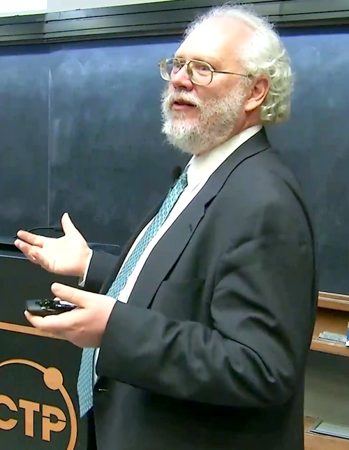

How did quantum computers survive their own noise?
Card 1 · 1994
Peter Shor, at AT&T Bell Labs in New Jersey, finds his factoring algorithm (page 7a). Suddenly quantum computers matter to code-breakers and governments.
Card 2 · The objection
Respected physicists push back. Rolf Landauer at IBM and Bill Unruh in Canada argue that noise and decoherence will wreck any real quantum computation. You can't copy qubits, you can't look at them, and their errors are continuous. How could you ever fix them?
Card 3 · 1995
Shor finds a way: spread one qubit across nine, and measure only whether groups agree (chapter 8). The code fixes any single error on any qubit, flips and wobbles alike.
Card 4 · The rush
Within a year Andrew Steane in Oxford finds a seven-qubit code, and Robert Calderbank, Shor and Steane build a general recipe. Shor then shows how to correct errors even while the computation is running.
Card 5 · The threshold
By 1997 and 1998 several groups prove the threshold theorem: below a certain error rate, quantum computers can run as long as you like. The impossible becomes an engineering target.
Card 6 · Since then
Shor moves to MIT. He wins the Nevanlinna Prize in 1998 and shares a Breakthrough Prize in 2023. In December 2024, Google shows the threshold working on real hardware (chapter 8).
Check
One quick one
Collect
Your aha card
Two breakthroughs, one mathematician.
Shor showed what quantum computers could break, then how to keep them from breaking.