Go further · Chapter 14 · 14c · People story
Who invented the laser, and how?
The short answer (tap to open)
Charles Townes, an American physicist, had the key idea on a park bench in Washington in 1951: use excited molecules to amplify microwaves. His team built the first maser in 1954, and he and Arthur Schawlow showed in 1958 how to do the same with light. Theodore Maiman built the first working laser in 1960.
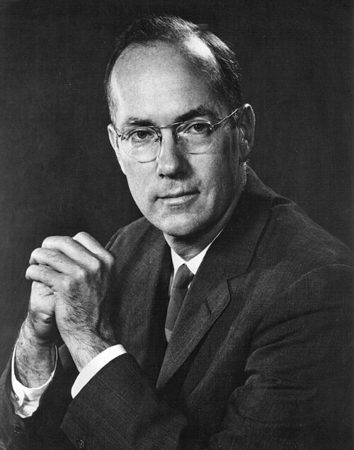


How did a park bench lead to the laser?
Card 1 · The problem
In 1951 Townes, a physicist at Columbia University in New York, wants to make microwaves of shorter and shorter wavelength to study molecules. Ordinary electronics can't go that short.
Card 2 · The bench
One spring morning in 1951 he's in Washington for a Navy committee meeting about exactly this problem. He wakes early, walks to a nearby park, and sits on a bench among the azaleas. There he works out on the back of an envelope that molecules pushed up an energy step (chapter 1) could all release their energy together, amplifying a wave instead of absorbing it.
Card 3 · Colleagues doubt it
Back at Columbia, senior physicists tell him it won't work, and to stop wasting the department's money. He carries on with his student James Gordon and a young researcher, Herbert Zeiger.
Card 4 · 1954, the maser
Early in 1954 their device works: ammonia molecules amplify microwaves. They call it a maser, for microwave amplification by stimulated emission of radiation, the process Einstein described in 1917 (page 1a).
Card 5 · 1958, light
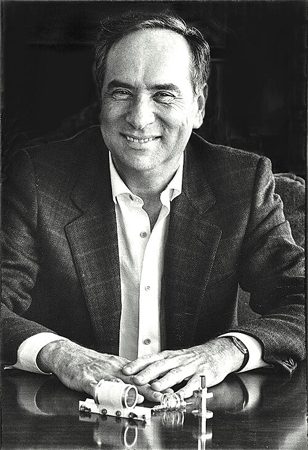
Townes and his brother-in-law Arthur Schawlow publish how to build an "optical maser" using mirrors at each end. In May 1960 Theodore Maiman, at Hughes Research Laboratories in California, builds the first working laser from a ruby crystal.
Card 6 · 1964
Townes shares the Nobel Prize in Physics with Nikolay Basov and Aleksandr Prokhorov of Moscow, who built a maser independently in 1954.
Card 7 · Since then
Lasers read barcodes, carry the internet down optical fibres, cut metal, fix eyesight and cool atoms for clocks and quantum computers. The laser is quantum technology's first great success, and a reminder that useful things can take decades to find their jobs.
Check
One quick one
Collect
Your aha card
From a park bench to every barcode scanner.
The first quantum technologies took decades to find their uses.
Next in the path · Chapter 15
Who is building quantum technology, and where is the money going?
Next in the path