Go further · Chapter 9 · 9c · People story
Who won the 2025 Nobel Prize in Physics, and why?
The short answer (tap to open)
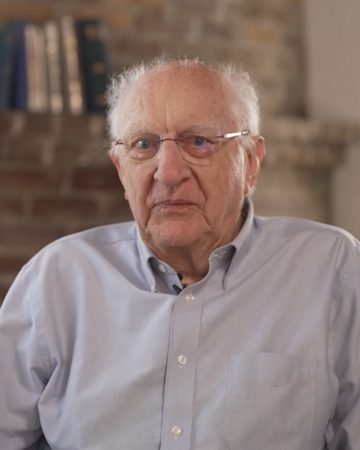
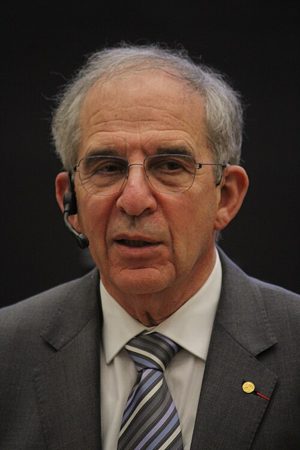
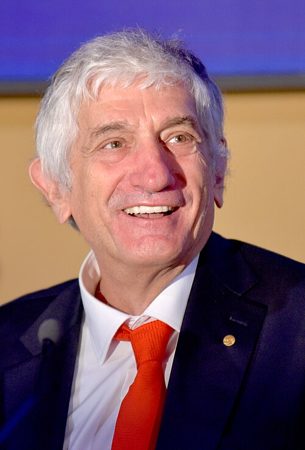
John Clarke, Michel Devoret and John Martinis won the 2025 Nobel Prize in Physics for experiments at Berkeley in the mid-1980s. They showed that an electrical circuit big enough to hold in your hand could behave quantum mechanically: tunnelling through barriers and sitting on fixed energy levels. That discovery underpins today's superconducting quantum computers.
_2025_(4x5).png)
.jpg)

How did a circuit you can hold turn out to be quantum?
Card 1 · The question
By the 1980s everyone knows atoms obey quantum rules. But do big things? Physicist Anthony Leggett asks whether a whole electrical circuit, billions of electrons acting together, could behave like a single quantum particle.
Card 2 · Berkeley, 1984
John Clarke leads a lab at the University of California, Berkeley, that builds exquisitely sensitive superconducting devices. Michel Devoret, a young French physicist, joins as a postdoc. John Martinis is a PhD student.
Card 3 · The experiment
They cool a small superconducting circuit with a Josephson junction (chapter 9), shield it from every stray signal, and watch it escape from a trapped state. At high temperature heat jostles it over the barrier. As they cool it, the escape rate stops falling: the circuit is tunnelling through the barrier, as only quantum objects can.
Card 4 · The ladder
Then they shine microwaves on it and find it absorbs only at certain frequencies: the circuit has fixed energy levels, like an atom (chapter 1). A man-made object, visible to the eye, behaving like an atom.
Card 5 · What came next
Those levels became qubits. Devoret went on to Yale, where his group helped develop today's superconducting qubit designs. Martinis led Google's hardware team for its 2019 Sycamore experiment (chapter 11).
Card 6 · October 2025
Forty years on, the three share the Nobel Prize in Physics "for the discovery of macroscopic quantum mechanical tunnelling and energy quantisation in an electric circuit".
Check
One quick one
Collect
Your aha card
A circuit you can hold, behaving like an atom.
The 2025 Nobel honours the discovery behind superconducting qubits.
Next in the path · Chapter 10
How do you build a qubit from light, silicon, Majoranas and annealers?
Next in the path